Key Takeaways
- The Hidden Side of OPCON: The transfer of Wartime Operational Control (OPCON) is not merely an administrative shift in command. It could serve as a strategic turning point for US Forces Korea (USFK) to transcend the ROK-US Combined Forces framework and operate more independently as a counter-China force in East Asia.
- An Exceptional Military Experiment: While US troops have operated under foreign command in various historical contexts, placing massive US strategic assets under a foreign (South Korean) general in a major theater of war—as proposed in the Future Combined Forces Command—is highly exceptional in US military history.
- Contrast with Japan: While South Korea seeks to reclaim operational leadership, Japan is actively strengthening its security ties by pursuing a “US-Japan Joint Command” heavily guided by US operational control.
- Victory is the Ultimate Priority: OPCON is not a matter of national pride. A forced transfer that risks structurally weakening the alliance must be avoided; the singular metric for evaluation must be the guarantee of an overwhelming victory in an actual conflict.
1. The True Meaning of OPCON Transfer and US Strategic Calculations
In South Korea’s current defense framework, the US military holds Wartime Operational Control (OPCON) over South Korean forces. Although Peacetime OPCON was returned in 1994, the authority to command joint forces during a full-scale conflict remains with the US four-star general heading the ROK-US Combined Forces Command (CFC). The proposed transfer will establish a Future Combined Forces Command led by a South Korean four-star general, with a US general serving as deputy.
While US forces have historically operated under foreign tactical or operational control (e.g., in NATO or multinational coalitions), placing a massive deployment of US troops and strategic assets under a foreign general in a primary theater of war like the Korean Peninsula is highly unusual. According to analyses by security publications such as The Diplomat, rather than confining USFK strictly within this exceptional combined structure, the United States is likely to gradually uncouple the command chains. This would allow USFK to operate more autonomously under the direct guidance of the US Indo-Pacific Command.
2. USFK’s “Strategic Flexibility” and the Intensifying US-China Rivalry
Historically, the absolute purpose of USFK was to act as a “tripwire” to deter a North Korean invasion. However, the dynamics shifted after Seoul and Washington agreed on the “Strategic Flexibility of USFK” in 2006. Today, the top priority of America’s global defense strategy is containing China’s expansion.
As analyzed by the Center for Strategic and International Studies (CSIS), if USFK remains exclusively under a South Korean-led combined command, the US would face severe political constraints in redeploying troops for regional conflicts like those in the Taiwan Strait or the South China Sea. The South Korean government might veto such movements to avoid antagonizing China.
Therefore, the US may utilize the OPCON transfer as a mechanism to loosen the combined command structure, thereby securing the extreme “strategic flexibility” needed to use USFK as a rapid-response strike force across East Asia. In particular, the unprecedented incident on February 18, 2026, where dozens of USFK fighter jets unilaterally scrambled toward the Yellow Sea (West Sea) ADIZ without prior consultation with the South Korean military—resulting in a highly tense mid-air standoff with scrambled Chinese People’s Liberation Army (PLA) fighter jets—serves as a stark prelude to this evolving role. The foreign affairs magazine The Diplomat incisively assessed this standoff as a “proactive demonstration of how independently and flexibly USFK could operate against China, free from the institutional constraints of the CFC, following an OPCON transfer.”
3. Uncoupling Command Roles and the Reshaping of East Asian Security
Currently, the USFK commander wears multiple hats—including CFC Commander and UN Command Commander—comprehensively coordinating the peninsula’s security. However, if the OPCON transfer relegates the US commander to a deputy role under a South Korean general, the USFK commander paradoxically sheds the institutional constraints of the CFC’s “joint consensus,” making it easier to exercise independent command over US assets.
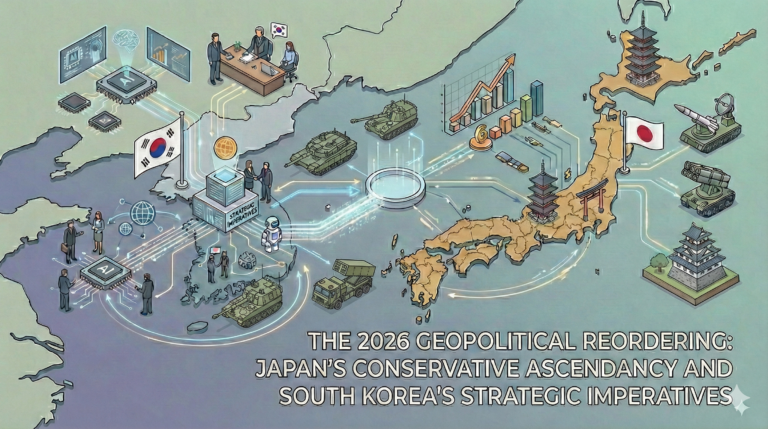
This contrasts sharply with the security posture of neighboring Japan. While South Korea endeavors to separate and reclaim command leadership, Japan is aggressively pursuing the creation of an integrated “US-Japan Joint Command” that effectively grants substantial operational control to US generals. This divergence strongly suggests that the epicenter of America’s Northeast Asian defense and force projection is rapidly shifting from the Korean Peninsula to the Japan-led “First Island Chain.”
Comparison of East Asian Joint Command Structures
| Category | Current ROK-US CFC | Future CFC (Post OPCON) | US-Japan Structure |
| Commander | US 4-Star General | ROK 4-Star General | Discussions for a US General-led integration |
| US Flexibility | Tightly bound to Peninsula defense | Wider latitude for regional (e.g., Taiwan) intervention | Integrated within the 1st Island Chain defense |
| Alliance Cohesion | Highly cohesive single command structure | Risk of fragmentation due to uncoupled command | Drastic strengthening of US-Japan military integration |
Source: Synthesized from CSIS East Asia Alliance Reports and The Diplomat’s security analyses.
4. Commentary: OPCON Transfer Must Prioritize Winning the War
National security cannot be safeguarded by sentimental slogans or political ideology. In the dire crisis of an all-out war where the nation’s survival hangs in the balance, only one value matters: “Winning the actual war to guarantee the survival of the people.”
Some factions approach the return of OPCON through a romanticized lens of “completing self-reliant defense” or “restoring national pride.” However, OPCON is neither a yardstick of sovereignty nor a political trophy. It is simply the most efficient and rational military operational “system” designed to win wars. The current CFC structure, which flawlessly integrates the intelligence assets, strike capabilities, and overwhelming battlefield management experience of the world’s most powerful military into South Korea’s defense posture, has provided the most potent war deterrence on the globe for decades.
If pushing for an OPCON transfer based on “pride” leads to a bifurcated command structure, a dilution of the US regional defense commitment, and structural cracks in the ROK-US alliance, it will inflict an irreversible fatal blow to national security. The transfer of OPCON must only proceed when there is a cold, pragmatic, and definitive answer to the question: “Does this transition guarantee a stronger, more flawless combined defense posture capable of prevailing against threats from North Korea and surrounding great powers?” Foolish decisions that jeopardize the safety of the nation to save face will never be forgiven by history.
Glossary of Key Terms
- OPCON (Operational Control): The authority delegated to a commander to direct military operations to accomplish a specific mission. In South Korea, it is divided into Peacetime and Wartime control.
- CFC (ROK-US Combined Forces Command): The central body of the joint defense system between South Korea and the US, established in 1978.
- Strategic Flexibility: The US global military strategy allowing troops stationed in one region to be rapidly deployed to any conflict zone worldwide, rather than being confined solely to the defense of their host country.
- First Island Chain: A strategic maritime defense line connecting Kyushu (Japan), Okinawa, Taiwan, and the Philippines, central to the US strategy for containing China’s naval expansion.
By Ten | February 24, 2026