KEY TAKEAWAYS
- Japan’s Strategic Dominance: The Liberal Democratic Party’s (LDP) 316-seat landslide victory in February 2026 has established a “Golden Era” for the U.S.-Japan alliance, positioning Tokyo as the primary anchor of American Indo-Pacific strategy.
- The Risk of “Strategic Bypass”: Under the U.S. doctrine of “Flexible Realism,” Washington increasingly views Japan as its premier partner, creating a distinct risk that South Korea’s strategic importance will shrink relative to its neighbor.
- Counter-Marginalization Strategy: To maintain its standing, Seoul must institutionalize its $350 billion Strategic Trade and Investment Deal (STID) with the U.S., specifically leveraging its world-class shipbuilding and technology sectors.
- Trilateral Necessity: Collaboration with Japan is no longer a choice but a structural requirement to eliminate security “seams” and prevent the redistribution of U.S. forces away from the Korean Peninsula.
- Global Integration: South Korea must pivot from a peninsula-focused actor to a “Global Pivotal State” by seeking permanent G7/G8 membership and deepening functional ties with NATO (AP4).
Introduction: Navigating the New Indo-Pacific Order
The global geopolitical landscape experienced a seismic realignment in early 2026, fundamentally triggered by the historic electoral triumph of the Liberal Democratic Party (LDP) in Japan. Under the resolute leadership of Prime Minister Sanae Takaichi, the LDP’s landslide victory in the February 8, 2026, general election has not only consolidated domestic power to an unprecedented degree but has also recalibrated the strategic priorities of the United States within the Indo-Pacific theater.
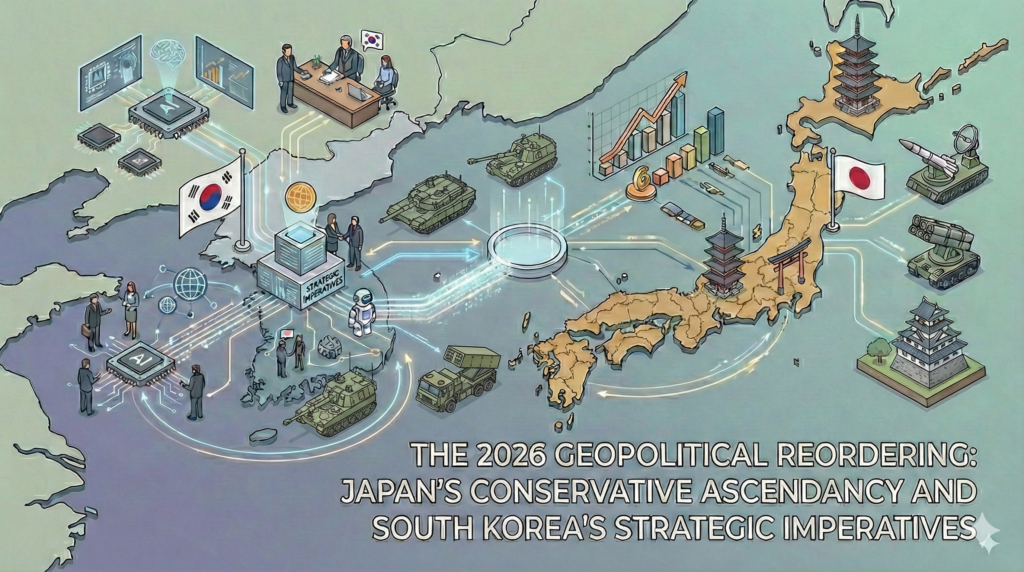
For the Republic of Korea (ROK), these developments represent a double-edged sword. As Japan emerges as a more assertive, militarily capable, and politically stable cornerstone of U.S. regional strategy, South Korea faces the distinct risk of strategic marginalization—a phenomenon characterized as the “shrinking” of its international standing relative to its neighbor. To navigate this transformative era, Seoul must transcend the limitations of traditional “pragmatic diplomacy” and commit to a rigorous three-pronged strategy.
The Takaichi Mandate: A Tectonic Shift in Japanese Politics
The general election results for Japan’s House of Representatives resulted in a political reconfiguration that effectively ended the era of fragmented governance. Prime Minister Sanae Takaichi secured a supermajority, granting her administration a nearly unfettered mandate to pursue a right-wing agenda centered on defense modernization and economic resilience.
Statistical Analysis of the 2026 General Election
The scale of the LDP’s victory is historically unique in Japan’s post-war era. The consolidation of 316 seats by the LDP alone provides the party with a two-thirds majority in the 465-member lower house, allowing it to override the House of Councillors on critical legislative matters.
| Political Party | Seats Won (2026) | Pre-Election Total | Net Seat Change |
| Liberal Democratic Party (LDP) | 316 | 198 | +118 |
| Japan Innovation Party (Ishin) | 36 | 34 | +2 |
| Ruling Coalition Total | 352 | 232 | +120 |
| Centrist Reform Alliance (CRA) | 49 | 167 | -118 |
Source: Nippon.com
This mandate allows Tokyo to accelerate its defense modernization and security reforms, including lifting defense spending to 2% of GDP and potentially proposing constitutional amendments to Article 9.
The LDP’s landslide victory underscores the stability of Japan’s political system. However, in an era where democratic processes are increasingly scrutinized, maintaining high standards of transparency is essential. To understand how vulnerable South Korea’s elections might be, read our analysis on global election integrity and A-WEB’s role.
The Strategic Bypass Risk for South Korea
The emergence of a stable, hawkish leadership in Tokyo has been met with immediate support from Washington. Under the 2026 U.S. National Defense Strategy (NDS), operationalized through the framework of “Flexible Realism,” the U.S. seeks to enable capable allies to provide the “primary conventional defense” in their own regions.
As the U.S.-Japan relationship evolves into a “Super-Axis,” South Korea faces the risk of a “Strategic Bypass.” This occurs when the primary theater for regional security coordination shifts toward the U.S.-Japan-Australia axis, leaving Seoul as a secondary player focused almost exclusively on the North Korean threat. Furthermore, the NDS expects South Korea to take “primary responsibility” for its own defense against North Korea, which may allow U.S. forces to be redistributed to address challenges in the Taiwan Strait.
Pillar I: Strengthening the Alliance under the Banner of Liberal Democracy
To counter strategic marginalization, South Korea must redefine its alliance with the United States as an indispensable, value-based partnership that extends far beyond the Korean Peninsula.
The $350 Billion Strategic Investment Deal (STID)
A cornerstone of this reorientation is the November 2025 “Strategic Trade and Investment Deal” finalized between President Lee Jae-myung and President Donald Trump. This agreement, involving a massive $350 billion investment pledge into the United States, directly addresses “America First” priorities.
| Sector of Investment | Committed Amount (USD) | Strategic Objective |
| Shipbuilding & Repair | $150 Billion | Resolving U.S. Navy backlogs; shipyard modernization |
| Advanced Technologies | $200 Billion | AI, 6G, Semiconductors, EV batteries |
| Total Commitment | $350 Billion | U.S. Industrial Revitalization |
Source: The White House
Through this agreement, South Korea has evolved into a global comprehensive strategic alliance partner, transforming its status from a recipient of aid to a core national security partner of the United States. By committing to this new framework for alliance modernization, South Korea transforms its relationship with Washington from one of dependency to one of pragmatic mutual respect and shared responsibility.
Pillar II: Institutionalizing Strategic Collaboration with Japan
The second strategic imperative is the formalization of collaboration with Japan. In the 2026 geopolitical environment, ROK-Japan cooperation is an essential extension of the U.S. alliance framework. A fractured relationship between Seoul and Tokyo creates a “seam” in the democratic defense architecture that adversaries can exploit.
The integration of Japanese space-based surveillance and South Korean industrial production capacity creates a “Kill Web” that significantly enhances regional deterrence. By “compartmentalizing” historical disputes and institutionalizing a “new normal” of security and economic coordination, South Korea can ensure it remains a core node in the U.S. regional strategy rather than a peripheral actor.
Pillar III: Expansion of Collaboration with the Free World
The final component of South Korea’s strategy is its integration into the global democratic infrastructure to mitigate the “shrinking” of its international standing.
G7 Expansion and the “Group of Eight” (G8) Proposal
There is a growing international consensus, supported by the Heritage Foundation’s recent report, that the Group of Seven should be expanded to include South Korea. South Korea’s “notable democratic resilience” and status as the world’s fifth military power make it a natural candidate for the G8. Permanent membership would effectively “upsize” South Korea’s standing, providing a platform to influence global policy on an equal footing with Japan.
NATO and the AP4 Framework
South Korea’s ties with NATO, formalized through the 2023-2026 Individually Tailored Partnership Programme (ITPP), signal a transition toward being a contributor to global stability. As a member of the “Asia Pacific 4” (AP4) alongside Japan, Australia, and New Zealand, South Korea is now part of a strategic rapprochement with the Euro-Atlantic region. This cooperation includes participation in the NATO Battlefield Information Collection and Exploitation System (BICES) and serving as a defense industrial force multiplier for NATO members.
Strategic Conclusion
The landslide victory of Sanae Takaichi’s LDP in February 2026 has fundamentally altered the strategic equation in East Asia. For South Korea, the challenge is to evolve in a way that prevents its standing from shrinking in the shadow of the new U.S.-Japan “Super-Axis.” By doubling down on the U.S. alliance through the $350 billion investment deal, institutionalizing cooperation with Japan, and expanding its role within global architectures like the G7 and NATO, South Korea can transcend its regional limitations and secure its position as an indispensable pillar of the Free World.
Glossary of key terms
- Flexible Realism: A U.S. strategic framework that seeks to align global commitments with finite resources through prioritization and burden-sharing with capable allies.
- Deterrence by Denial: A security posture aimed at making military aggression geographically or operationally infeasible, thereby discouraging adversaries from initiating conflict.
- Strategic Bypass: A scenario where major powers coordinate regional security primarily through a specific axis (e.g., U.S.-Japan), potentially marginalizing other regional partners like South Korea.
- Global Pivotal State: A vision for South Korea as a nation that contributes significantly to global security, technology, and governance beyond the limitations of the Korean Peninsula.
- Kill Web: A decentralized and integrated sensor-to-shooter network that utilizes multi-domain capabilities (space, air, sea, land) to enhance the speed and effectiveness of deterrence.
- MASGA (Make American Shipbuilding Great Again): A strategic initiative involving South Korean investment and technology transfer to revitalize the United States’ domestic naval industrial base.
- AP4 (Asia-Pacific 4): A partnership framework involving NATO and its four key Indo-Pacific partners: Australia, Japan, South Korea, and New Zealand.
By Ten | February 10, 2026