KEY TAKEAWAYS
- The “12345” Smoking Gun: A 2023 official audit by South Korea’s NIS revealed that national election systems were protected by the world’s most basic password, allowing for “ghost voter” insertion.
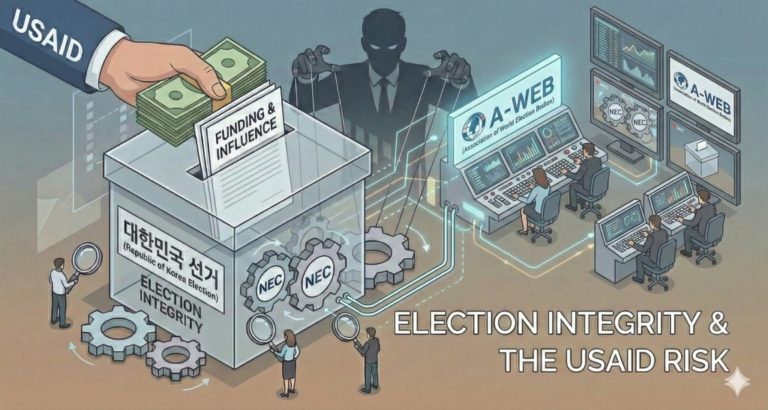
- The USAID-A-WEB Nexus: Millions in U.S. funding have supported A-WEB, a South Korea-led organization that “exports” digital election architectures now proven to be structurally insecure.
- Architectural Crisis: This is not about parties; it is about a “black box” design that favors centralized manipulation over transparent, manual audits.
- Global Warning: As the U.S. heads toward 2026, the South Korean case serves as a technical proof-of-concept for how modern democracies can be compromised from within.
The “12345” Smoking Gun: A Case for Technical Failure
Election integrity reached a critical turning point as South Korea’s 12345 password scandal expose. For years, questioning digital election systems in the U.S. was dismissed as a fringe activity. However, in 2026, the narrative has shifted. Official government audits from South Korea—a premier global IT power—have turned speculation into documented technical fact. The “system” is not just hackable; in some cases, the door was left wide open.
1. The “12345” Revelation: A National Security Nightmare
In late 2023, South Korea’s National Intelligence Service (NIS) conducted a joint security audit of the National Election Commission (NEC). The results were catastrophic. The audit revealed that administrative accounts were protected by passwords as simple as “12345.” This was not a minor lapse. The NIS confirmed that:
- Remote Access: Hackers could penetrate voter registration systems from outside networks.
- Data Manipulation: The architecture allowed for modifying ballot counts without leaving a traceable digital footprint.
- Ballot Cloning: Digital seals for early voting were stored insecurely, enabling the potential mass production of unauthorized ballots.
These vulnerabilities were not merely theoretical; according to the official joint security audit report, the NIS and KISA confirmed that hackers could penetrate the voter registration system via external networks.
2. The Institutional Nexus: USAID and A-WEB
To understand the global implications, we must look at the Association of World Election Bodies (A-WEB). Headquartered in Songdo, South Korea, A-WEB has spent the last decade standardizing and exporting election technology.
This effort was not solitary. The United States Agency for International Development (USAID) has been a key partner, providing millions in funding to promote these digital infrastructures. For the American voter, this creates a disturbing feedback loop: U.S. taxpayers are funding the export of an election “black box” that has now been proven—by the very government that built it—to be structurally vulnerable.
This global expansion has been bolstered by strategic partnerships, such as the MOUs signed between A-WEB and international agencies including USAID, to promote digital democracy infrastructures in developing nations.
3. Architecture Over Partisanship
Just as we analyze “Regulatory Lawfare” in the corporate world, we must analyze “Architectural Vulnerability” in the democratic world. When election systems are designed to be opaque, they cease to be tools of the people.
The South Korean case moves the debate from “Could it happen?” to “How long has it been happening?” If a tech giant like Korea secures its democracy with a “12345” password while receiving international acclaim, the “trust us” era of election technology is officially over.
This architectural vulnerability is not unique to Seoul. As global election bodies increasingly adopt ‘black-box’ technologies funded by international agencies, the lack of manual auditability becomes a systemic risk. For 2026, the demand for transparency is not a partisan grievance but a technical necessity to ensure that democracy remains legible to the citizens it serves.
Conclusion: Back to Paper, Back to Proof
The path forward is clear. To restore trust, we must return to verifiable, human-scale processes:
- Paper Ballots: Physical evidence over digital shadows.
- Manual Audits: Transparency that any citizen can witness.
- Local Sovereignty: Removing the influence of opaque international networks.
Glossary of Key Terms
- Election Integrity: The assurance that all aspects of an election are free from manipulation and accurately reflect the will of the voters.
- USAID (United States Agency for International Development): A U.S. government agency primarily responsible for administering civilian foreign aid and promoting democratic governance worldwide.
- A-WEB (Association of World Election Bodies): The largest international organization of election management bodies, headquartered in South Korea, focused on strengthening the efficiency of election processes.
- Security by Design: An approach to software and hardware development that seeks to make systems as free of vulnerabilities and impervious to attack as possible through continuous testing and authentication.
- Architectural Vulnerability: A systemic weakness in the fundamental design of a network or system that allows for unauthorized access or manipulation, regardless of individual user actions.
By Ten | January 30, 2026