KEY TAKEAWAYS
- Industrial Impact: Excessive punitive measures may discourage transparent reporting and hinder the global competitiveness of the Korean IT sector.
- Disproportionate Penalties: The South Korean government is considering fines for Coupang that are significantly higher than those applied to similar or even larger-scale leaks in the past.
- Political Rhetoric: The use of terms like “National Disaster” and the involvement of six parliamentary committees suggest a political agenda beyond simple consumer protection.
- Regulatory Risk: Aggressive “showcase” punishments for domestic leaders like Coupang create a “regulatory handicap” compared to foreign platforms like AliExpress or Temu.
Context and Objective
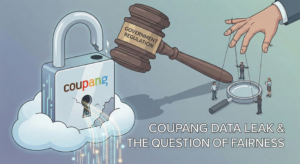
The Coupang personal information leak (affecting approximately 33.7 million users) at the end of 2025 stands as one of the largest security breaches in South Korean e-commerce history. However, what is equally unprecedented is the intensity of the government and political response. This post analyzes why the current pressure on Coupang is being criticized as “excessive” and “selective” when compared to past cases involving KakaoPay, SKT, and Chinese platforms like AliExpress and Temu.
1. Analysis: The “Double Standard” and Punitive Rhetoric
The South Korean government has escalated this incident beyond a standard security breach, treating it as a “national disaster.” The rhetoric used by officials suggests a shift from administrative oversight to political theater.
Hostile Rhetoric: Official statements suggesting that “the government must show that a company can fail due to such negligence” go beyond the rule of law and lean toward “corporate taming.”
Unprecedented Financial Pressure: Discussions regarding a maximum fine of 3% of annual sales (approx. 1.2 trillion KRW) are already on the table. Some lawmakers are even pushing for “special legislation” to raise this cap to 10% retroactively.
Political Mobilization: The simultaneous involvement of six parliamentary committees for a joint hearing is an extreme measure for a corporate security incident, suggesting a motive beyond simple consumer protection.
2. The “Mafia” Rhetoric: A State-Led Offensive
Last week, South Korean Prime Minister Kim Min-seok’s call to pursue Coupang with the “same determination used to wipe out mafias” was unprecedented. While regulators have every right to ensure compliance, equating a US-listed innovator to organized crime is a move that, in effect, amounts to a political hit job rather than neutral administration.
Comparison of Data Breach Responses by Company
To illustrate the disproportionate nature of the Coupang response, we can compare it with previous major leaks and their respective sanctions.
| Company | Context | Response & Tone |
| Kakao Pay | Leaked data of millions to China’s Alipay. | Fined approx. $10M–$20M. Serious, but purely administrative. |
| SK Telecom | Massive breach affecting over 23 million users. | Fined and sanctioned, yet no “mafia” analogies were used. |
| Ali/Temu | Cross-border data issues and privacy concerns. | Fines around $1.5M or less; treated as a “market entry” issue. |
| Coupang | Search algorithm and privacy disputes. | Threat of fines exceeding hundreds of millions of dollars and aggressive “mafia” rhetoric. |
Source: Compiled by 1010log Research based on public disclosures from the Korea Fair Trade Commission (KFTC), the Personal Information Protection Commission (PIPC), and official transcripts from the Prime Minister’s Office (2025–2026).
3. Legal Issues and the Risks of Over-Regulation
The current approach poses several risks to the broader tech ecosystem and the principle of fair governance:
- Violation of the Principle of Proportionality: In cases where “intent” to leak is absent, imposing fines that threaten a company’s very existence violates the legal principle of proportionality.
- Reverse Discrimination: While foreign platforms (AliExpress, Temu) often escape with “slaps on the wrist” due to jurisdictional hurdles, domestic leaders like Coupang are subjected to much harsher standards, creating a “regulatory handicap” for local businesses.
- Disincentivizing Transparency: If the penalty for a breach is corporate “execution,” companies may be incentivized to conceal vulnerabilities or minor incidents rather than reporting them transparently for the sake of public safety.
4. Expectations and Future Outlook
The government’s response to Coupang will set a precedent for how IT companies are treated in South Korea moving forward. If “punishment for the sake of example” becomes the norm, it will manifest as a significant regulatory risk that hampers global competitiveness. True data security is achieved through collaborative infrastructure investment and clear, realistic guidelines—not through punitive rhetoric that treats corporate entities as political targets.
Conclusion: From Growth to Governance
The Bottom Line has shifted. For NYSE:CPNG investors, you are no longer just betting on logistics efficiency; you are auditing the integrity of the jurisdiction itself. The real risk is whether South Korea will remain a rule-of-law democracy or continue its slide into an ideologically driven economy that views US capital with structural suspicion.
Glossary of Key Terms
- Principle of Proportionality: A legal principle stating that the severity of a punishment should be proportionate to the severity of the offense.
- Rhetoric: The art of effective or persuasive speaking or writing, often used in politics to frame an issue in a specific light.
- Regulatory Risk: The risk that a change in laws and regulations will materially impact a security, business, sector, or market.
- Administrative Penalty: A non-criminal punishment imposed by a government agency for a violation of laws or regulations.
- Reverse Discrimination (in Regulation): A situation where domestic companies face stricter regulatory standards than their foreign competitors operating in the same market.
By Ten | January 27, 2026